While Ziggy Stardust will live forever, today the news is filled with reports that Stardusts alter ego, David Bowie (Jones) died yesterday, Sunday, January 10th 2016. He no longer has five years.
Bowie was only two days into his 69th year.
LAZARUS
Bowie’s son Duncan confirmed the news on Twitter. A simple tweet; “Very sorry and sad to say it’s true.” This was paired with news from Bowies publicity team that he had been ill with cancer for at least 18 months. And while there had been much recent speculation surrounding the health of Bowie, the news came as a great shock to most everyone, but close family.
David Bowie Official on Facebook stated just this; “January 10 2016 – David Bowie died peacefully today surrounded by his family after a courageous 18 month battle with cancer. While many of you will share in this loss, we ask that you respect the family’s privacy during their time of grief.”
Bowie was last seen out in public at the Theatre Workshop, New York, on December 12th 2015. He was there to see a production by the name of Lazarus, based on his new single of the same name, which was released on his birthday, January 8th 2016. Though looking slim and tired, he was smiling and still gave time to fans that had come by to see him.
Lazarus was the most recent single from Bowies 25th and final studio album, by the name of Blackstar .
BLACKSTAR
Producer Tony Visconti today confirmed that the record was parting gift and final goodbye to fans. Bowie was telling the world about his approach to death and it would seem that he produced such an artistic piece, that we were all in awe of the brilliance and no one realized what he was saying…
Until yesterday, that is.
No one reading this article needs a discography, or calendar breakdown of Bowies career. Any music fan worth their salt already knows all that they need to know.
Everyone else should spend some significant time online enriching themselves.
Bowies eclectic career as an Artist spanned five decades. Take your time.
Recently, Art of Dying lent their song All I want Is Everything to a mini documentary by/about three homeless young folk, in collaboration with San Diego based Outreach; Urban Street Angels.
Music can always tell a story. This song shares a very poignant message.
Ladies of Rock With
Lita Ford, Vixen and Femme Fatale February 20, 2016
Doors 6 pm | Show 8 pm
Tickets Start at: $29.50
Lita Ford is considered one of the most important female representatives of the rock genre. Being a founding member of the Runaways, one of the first girl groups who unexpectedly broke down barriers in the punk era as well as the male-dominated world of rock music, causing a stir with their six rebellious releases.
VIXEN is the only all-female hard rock band from the 80`s who sold over a million albums, had six #1 videos on MTV and had four songs in Billboard’s Top 100. The group Vixen-ized their fans on worldwide tours with heavyweights Deep Purple and KISS, which fueled the international frenzy.
Femme Fatale is one of metal’s favorite bands & Fronted by the sexy, sultry, in your face vocals of Lorraine Lewis – one of Metals few women pioneers. Femme Fatale’s self titled release (produced by Jim Faraci & Tom Werman) on MCA Records in 1988 spawned 2 unforgettable breakout videos – “Waiting For The Big One” & “Fallin’ In & Out of Love” – which landed on the top 10 heavy rotation for MTV & VH1 & on the Billboards Hot 100. Femme Fatale is known for their mega-watt live performances – has toured across the country and overseas & was the center focus for some of metal’s top selling magazines. Femme Fatale is featured on hair nation Sirius satellite radio and ready to catch the world
Join us at the River Cree Resort and Casino for a night of full of Rock N Roll!
Must be 18+. All tickets and packages are final sale.
Yes, People Still Say That Shit To Female Musicians
Everyone is equal.
That has been my long-held belief and the reason I started calling myself a “humanist” in high school. Feminism, for me, wasn’t enough; as the recent re-education surrounding modern Western Feminism (with a capital F) will attest: “Cultural patterns of oppression are not only interrelated, but are bound together and influenced by the intersectional systems of society. Examples of this include race, gender, class, ability, and ethnicity.” Intersectionality, a term coined by Kimberlé Crenshaw in 1989, has in recent years found its way onto the tongues of people of every imaginable background. The fact that I choose personally to extend my inclusiveness in humanism to every living being on Earth — plant, animal, or other — is a broader subject for another conversation entirely. Let it be said, however, that as aware as I am of the immense challenges facing virtually everyone on the planet except for me my cognizance does not negate the tiny niggling instances of disrespectful treatment I’ve encountered as I meander meaningfully through life.
Everyone has a right to tell their story.
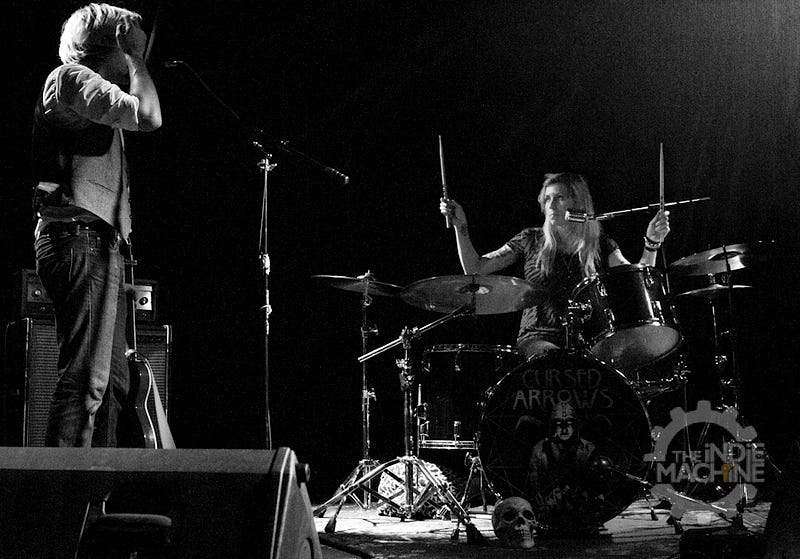
Performing in front of an audience is empowering. The energy exchanged between interested parties at both ends of a venue is palpable. A decade ago, I had barely tested the waters of public performance, having only accompanied my partner at a couple of shows. I’d played an organ, a glockenspiel, percussion instruments, and I’d sung backup. On those occasions, I was terrified, like most musicians are when they first step onstage. As months and years crept by I began playing whole sets: song after song of excruciating catharsis as audiences alternately smiled, applauded, looked unimpressed, or ignored the efforts of us musicians. I practiced drumming for several hours every day, eager to escape my myriad day job commitments and hole up in a basement with my instruments. I loved drumming. I loved singing. The terror began to subside as I took ownership of writing every drum part, and began to write my own lyrics and vocal melodies. I helped shape and structure songs, and alternately marvelled and shrivelled at varying audiences’ responses to these substantial pieces of myself. In short, I did what every musician does.
Day after day, I simply went for it.
Photo Credit: The Indie Machine
Something of which I was never aware was my gender or appearance. For years I dressed for comfort, like the majority of sweaty drummers in rock bands might: t-shirt, jeans, sneakers, hair loose, no make-up, and no bra. The early gatherings and concerts we played were populated by folks of every imaginable background, and that felt right. As University campuses and house shows expanded into bars and nightclubs, however, the vibe shifted. I started to feel as though I was being watched closely; perhaps even examined. We’d walk through the door early in the night with our gear ready for sound check, and my presence would be questioned.
“Are you with the band?” A bouncer would inevitably ask this at every show. Sometimes, he’d even hold up his hand to stop me from entering the venue. (95% of the time, door staff are male). “Yes, I’m in the band, Cursed Arrows.” The bouncer would then turn his head to my male partner and band mate. “Is she with you?”
After dealing with the occasionally awkward incredulity of the door and bar staff, we’d go about our business setting up for sound check. Next we’d meet the “sound guy” (99% of the time, sound engineers at the 300+ venues I’ve played have been male). At first I didn’t notice that they’d never acknowledge me. I was too busy setting up my drums. After all, drummers in general are not highly regarded. What caught my attention was the frequency with which they’d fight me on the simplest matters. First they’d be shocked, night after night, city after city, that I was a singer, too. “She just sing back-up?!” Sound guys would yell across the stage to my partner instead of simply asking the woman in question, setting up her drums six inches away. “No,” I’d answer myself. “I sing lead on many songs.” They’d insist on placing and positioning my mic stand for me. As a singing drummer, I obviously had developed a preference for where and how my mic should be positioned. I’d have to ask repeatedly for a monitor near the drums/facing the drums/expelling sound at a volume at which it was useful to me behind the drums. Once again, none of these are unusual problems for a small-time gigging drummer. Yet, something always felt extra presumptuous with most of these guys.
I’d usually check my drums without incident, and they’d have nothing to say about my ability to play. Then I’d check my vocal mic and they’d insist on keeping the level down to background noise, so stuck in their heads was it that I was just the “back-up singer.” I’d come offstage after sets and people would tell me, “You guys were amazing! But I couldn’t hear your vocals,” over and over again. I’d be severely disappointed, but shrug it off. None of us were getting paid well for these shows, and the sound guys rarely took their jobs seriously, at least when I was around.
Yet I began to notice that when I had any requests or expressed any preferences whatsoever as to how the night would go or stage might be set up, I’d be met with pursed lips and a shaking head every time. Meanwhile, the next act on the lineup (80% of the time a band of four males) would make a similar request — say, insisting that they set up their drums side-stage or use their own kit versus the house kit — and nary a word of disapproval would pass the sound guys’ or promoters’ lips. When I informed them of similar changes to setup, usually a very simple statement that I’d be setting my drums up a few inches closer to the front of the stage to facilitate a well-placed vocal mic and my ability to climb back and forth from the front of the stage to my drum stool, I would universally be met with eye-rolls and complaints that I was wasting everyone’s time. Then, when my time was up and we’d sound checked efficiently and exited the stage, I’d consistently overhear the next band setting up. There’d be jovial back-slapping in place of sarcasm and plenty of meandering, elaborate stage plot requests wordlessly fulfilled. Once again, you can usually chalk this all up to being a guitar-and-drums duo (an often derided band configuration) or simply being unknown. Over and over again, dozens of shows later, though, I realized: I’m on a bill with several other two-person bands. I’m the headlining act. The promoter asked my band to headline this show, yet my very simple requests to a) be audible as I sing and b) set up my instruments to my liking are being fought at every turn while the opening acts (virtually always comprised of two males) seem to have no trouble at all taking their sweet time setting up and performing however they please.
Other bands were just as guilty of downplaying the equality of my presence in situations in which it was insisted upon that “all drummers share a kit.” This is by no means unusual, and typically the reasonable assumption. When I’d show up with my own kit and be the exception to the rule — preferring not to use the battered communal kit with broken hardware, punctured batter heads, and an overall inferior sound — I’d be flatly denied the option of using my own drums. More often than not, I’d relent out of what I thought was mutual respect, agreeing to use the shared kit and suffering through a mediocre sounding set because of my decision. After a couple of shows like this, though, I noticed that once again, bands on the same bill would walk in with their kits, insist on using them, not back down, and “waste everyone’s time” setting the garbage kit side-stage while they performed happily under conditions closest to their liking. Then it’d be time for my set and I’d be left with “no time!” to set up my own drum kit. No, I’d have to use the shitty one, or risk infuriating the sound guy, promoter, and any other bands on the bill that night. Something didn’t add up properly.
Fellow drummers liked to run up to me just before I began my set and ask if I needed sticks. Or a drum key. Or “help setting up” my own cymbals or mic stand. To this day, hundreds of shows later, I’ve never noticed men pre-emptively doing this to other male drummers. Not once. (My response to all of these queries, as you may have guessed was “No, thanks. I come prepared.”)
After our sets were over, my partner and I would swallow our exhaustion and satisfaction and quickly get our things out of the way for the next act; such is the hectic life of an independent band without roadies. We have rarely been shown the same respect by bands who perform before us, but it goes without saying that few people mind their manners in such a setting. Our set-times have been cut severely short by opening acts moving at a glacial, remedial pace before, during and after their allotted time. When this has happened, we’ve been shown no mercy; shooed off the stage or unplugged mid-song while miraculously, the bands before and after us are given free reign to go over their budgeted time slot. Finally, after years of this sort of treatment we began asking ourselves and each other: “What, exactly, is going on here? What is different about us?”
Having left the stage as promptly as we could, sweating and lugging our gear backstage my partner has been routinely accosted. Generally he’s met with typical questions: “What pedals do you use?” “Where’d you get thatguitar, man?” or “I love your tone.” Very often, though, the first thing he has heard is: “You guys were great. So, what’s the deal with your…uh…drummer…?” Uncertain at first of what the hell they were talking about, he’d typically just look at the person blankly, frankly wondering what they meant. “She’s foxy! Are you guys siblings, or…?”
Ah. So there it was. These eager dudes, running right past me and up to my band mate, wanted to answer a burning question: is she single? My partner’s concise and honest response — “We’re married” — always cut the conversation short. “She’s a really good drummer, man,” they’d tell him, and he’d agree, and they’d part ways with me standing a few inches away and observing them in amazement. Of course, this is part of being a musician. The people onstage are mysterious; they’re there for a night to pour their hearts out for you and then they disappear. It’s natural to want to know more.
Why, though, has virtually no one ever approached me and asked, “What’s the deal with your guitarist? Are you guys, like, a couple or something?”
Booking shows is another challenging arena for any DIY performer. I took on the brunt of this duty for many years, with my partner’s agreement and involvement, of course. Yet I had to be cautious about letting promoters know which one of us was corresponding with them. On one of our tours from the East Coast through Southern Ontario, I contacted an established promoter with his own venue in my hometown, several months ahead of our tour dates, to ask if he’d be interested in setting up a show with us. He agreed, told me the other two bands who’d be on the lineup, and said he was looking forward to it. I pencilled it in. As the weeks and months passed I followed up to confirm the show and ask if he needed any help promoting it; making posters, etc. He didn’t respond. Finally, three weeks before we left for our tour I sent a final email asking for him simply to confirm that the show was NOT happening. I figured that was the least he could do out of mutual respect.
His response was to contact my partner in a separate email, apologizing that he hadn’t had time to put together the show; thus the show (as we’d rightly assumed) was not happening. Yet he felt the need to complain that he “didn’t like her behaviour” and “didn’t want to work with us again” because I had had the gall simply to follow up on our previously jovial show-booking conversation. He’d ignored two of my messages but chosen to email my male partner instead, effectively asking him to ‘control his woman.’ This type of interaction occurred more than once, until I stopped making it evident which band member was the one sending out booking emails.
By far the least enjoyable aspect of performance, at least when you first start out, is heckling from an audience. Sure, some folks thrive in the midst of confrontation but most musicians would very strongly prefer to simply play their music for people who want to hear it. Once heckling began, and we were the only act attracting such behaviour, I begrudgingly started to believe that it might have something to do with the fact that I’m a woman.
After one of our earliest shows, at a beloved all-ages venue run by friends in Brantford, ON, a young male whom I’d noticed complimenting my partner after our set ran up to me outside the venue and smeared some sort of grease all over the back of my shirt. Not only had he grabbed and touched me against my will, but he’d destroyed the fresh clean shirt I’d changed into after a sweaty performance. Furious, I confronted him moments later and insisted that he apologize. Of course, he refused. I changed tactics and demanded that he pay for the shirt he’d destroyed. Stared down by me and a bunch of my male musician friends, including my partner, the guy just smiled and said, “I’m not paying for your goddamned shirt.”
“Girl drummers suuuuuuuuuuuuuuuck!” a very large drunk man once screamed in between songs years later, at a popular bar in Hamilton, drowning out the sound of appreciative clapping from a couple dozen show-goers.
Once, after a fairly pleasant set at a Toronto dive bar booked by a very well-known and influential show promoter who shook our hands, paid us well, and offered his genuine respect for our talent after the show, I returned home to an email to our band address that read just two sentences long:
“Your band sucks. Break up now, thanks.” I deleted the message, but not before I recalled a particularly smarmy looking dude who’d been standing at the bar earlier that night and had said, “Nice tits” with a smirk when I walked up to ask the bartender for a glass of water. “Fuck yourself,” I’d told him. My memory wanted to piece together who’d despised us enough to write such a note, but consciously, I simply wanted to forget the incident. Clearly, I have not.
At a bar in Guelph, we once opened up for a fellow two piece; a heavy-as-fuck bass-and-drum duo of two very seasoned veteran male musicians. They were loud as anything; twice as bass-heavy as us; it was a rock show. Yet, early on in our set one particular audience member kept screaming,
“You guys are TOO LOUD!!! I CAN’T HEAR MY FRIENDS!” Keep in mind, this guy had paid to be there.
We ignored him, and played on, amused with the rest of the audience, until he walked right up onstage and started staring me down. He tried grabbing my cymbals mid-vibration, so I gave him my scariest look and hit him with one of my drum sticks “accidentally.” He called me a “fucking bitch,” and I kept playing. His intimidation did nothing, so he moved over to my partner and tried to grab his guitar and yell into his mic in between songs, repeating the same mantra about us being “too loud” and him not being able to hold down a conversation. At a rock show. In a dirty old tavern. He got whacked again, this time accidentally, with the neck of a baritone guitar, dropped his beer glass and finally went outside. When we left the venue that night we saw him being coaxed off the side of a building, to which he clung precariously like a delirious squirrel, by police.
During a brief quiet moment as I wailed on my drum kit one night in Halifax, I heard a very distinctly enunciated “TAKE OFF YOUR SHIRT! SHOW ME YOUR TITS!” from the back of the bar. This took place at one of the oldest, most steadfast venues in the city, where we’d performed several times over the preceding four years. I said something into my mic after the song finished about respecting the musicians onstage, and heard male laughter from the back of the room. Always in the shadows.
On one evening, as we were setting up to sound check at a legendary 70-year-old tavern with a capacity of a few hundred, a bar patron walked up to the stage and said with what sounded like syrupy condemnation, “Hey sexy drummer girl! You’re cute.” Then he simply walked away. Without having heard a note of music, or seen what my abilities were as a musician, this man had waltzed all the way from the front of the venue to the stage just to try and make me uncomfortable. I didn’t feel threatened by any means, but after years of comments and smirks and insults and the occasional physical assault, I was done keeping my mouth shut. During our set I quickly recounted what had been said to me during sound check and finished with, “If whoever that was thinks I showed up here tonight so that he could insult me and check out my body, then FUCK HIM. I’m here to perform the songs I wrote for the people who give a shit.” A couple of people clapped hesitantly, mostly the fans who’d come specifically to see us perform. We played a great set and had fun chatting with some kind folks afterward.
Later that night, however, we received a nasty email from the promoter stating that “our band was no longer welcome at any events booked by Such-and-Such Concerts” as we had “failed to promote the show on our Facebook page.” Funny, I thought, I’d been posting about the show online for weeks. Yep, there it was online, plain to see. And we’d gotten a handful of fans out that night, as requested by the promoter. It had turned out better than most of our Toronto shows, so it seemed amiss that we’d be “banned for life” from performing for simply showing up on time, bringing fans, and playing our set whilst keeping to our allotted set time. I smelled bullshit.
Somewhere around 2013, I grew tired of the disrespectful culture in which we found ourselves and we scaled back the number of bar shows we played. This, of course, helped. All ages shows are inclusive of young people, and rarely resulted in as much male-centric bad-mouthing as those that took place in bar settings, however well-attended and appropriate to our music those bar venues tended to be. Alcohol sales result in money for bands, more often than not, so we also unintentionally started making less money. Failing to break even for the first time in years. This is punk rock, we told ourselves, and we followed our hearts.
Photo Credit: Geoff Fitzgerald
My instinct told me to write even more of my own songs, and to stand up front. I started playing guitar almost exclusively. Though I still dressed primarily for comfort, I also began to wear makeup at every show (sweat-dripping-eyeliner be damned; I loved it) and keep my breasts covered, either by vests or comfortable bras. I had learned so much from my 7 years as an unassuming singing percussionist. As a seated female drummer, I had appeared subservient to too many observers. I always wanted my lyrics to be heard. I wanted audiences to watch my hands, and my stage moves, not my unintentionally bouncing breasts. After a decade of not giving a shit about abiding by cultural norms, I found a way to subvert them whilst staying comfortable in my own skin. I dressed and wrote punk songs to my liking, and I began to perform standing at the front of the stage, side-by-side with my partner. We were two people with guitars, and while we had always been an equal musical partnership, we finally appeared equal.
Unsurprisingly, people’s attitudes changed. My partner booked a lengthy tour performing at many of the same types of bar venues we always had — with a good percentage of all-ages shows thrown into the mix — and we managed to play show after show with nary a problem from bouncers, sound techs, venue staff, promoters, or other bands. No audience members heckled us, even as we encroached on 50 shows in 50 different Canadian cities. Nobody commented on my body, and males and females alike started coming up to me after our sets and talking to me respectfully about our music.
Was it really that simple?
Photo Credit: Wavelength Toronto
By standing at the front of the stage and engaging audiences while holding a microphone instead of singing equally heartfelt words from behind the drums, had I really managed to shift everyone’s perception so…perceptively?
Was it all a fluke?
Regardless, I am committed as I go forth in life that doing what I love — performing music — will always meet roadblocks, but they can easily be overcome. Refusing to allow our own stubbornness to trap us in situations with disrespectful people opens up a delicious new world of contentment. I still don’t give a shit what people think of me, deep down. I don’t wear a bra or makeup unless I genuinely want to decorate myself. I continue to show others the respect I have always had for every other person I meet, and I vow to put myself into situations that meet my expectations for personal growth and human connection.
Art flourishes in both agony and ecstasy.
Shitty people don’t deserve my anger; thus they no longer receive it.
I love helping others realize that everyone is equal.
I love playing music, and telling stories.
NONE of which were born with the names listed. Some of them of course legally changed the names they were given at birth. Others are/were known just by nicknames. But that is how people know them. It’s how members of the public recognise them. It is ludicrous to assume that Rhianna, Paul Stanley or Tom Cruise would be asked to use a birth name on a social media site, or elsewhere, for that matter. No-one would know who the fuck they were.
How about Kat Von D, Deadmau5, Ice T, or Banksy. Let’s insist they become a name that no-one ever heard of?
Yet Facebook seems to pick and choose who it allows to use a different name, even though those people may have signed up to use Facebook with the stage name they use, and they have likely used it for 20 plus years.
What is being referred to here is the recent decision by Facebook to disallow Dogs D’Amour drummer Bam Tastic, to continue to use his name. A name he has been using for some 30 years.
We all know it’s highly unlikely that someone was named Bam by his parents in the 1960’s, however likely it may be now. But it’s ridiculous to exclude a person from social media purely based on a stage name. It is true, this was not the name given at birth. But it IS his name. Facebook is seriously fucking up by trying to make this change.
Bams wife Share Ross (Vixen, Bubble, Joe Elliot) who is known to millions as Vixens bassist, also uses a name that was not given her at birth. No-one from Facebook has requested that she become someone she is not, to this point. It’s a possibility, but then people wouldn’t know who she is either….. Yes, it really is as ridiculous as it sounds.
Bam stated on his Facebook Artist page that “Well… UPDATE: my case is closed. I am not allowed to be Bam. Really? REALLY Facebook.”
It appears that Facebook is fickle. Canadian actress Avaah Blackwell was until recently known by her birth name on the social media site. Facebook were contacted by her, and she told us “I had to email Facebook and state my case. I explained that the artist had not changed, just the name.”
Avaah was allowed to change her name on Facebook.
And that other famous Bam (Margera)…. still on Facebook at the time of going to press!
Yet others such as Rocky Shades (Wrathchild, Wildside Riot), Katt Scarlett (Femme Fatale) and Bam (Dogs D’Amour, Bubble) have been forced to use their birth names, or leave the social media site.
Double standards? Nit picking? It sure as hell seems that way.
Let’s get this stupid rule reversed. It’s actually causing more harm and disruption than good.
GOOD LUCK Bam.
KG (Headbangerwoman) Sept 18th 2015
UPDATE: Around the same time that this article was published, Facebook reinstated Bam, using his birth surname of Ross.
Welcome back Bam Ross!




 Turn It Up To Twelve